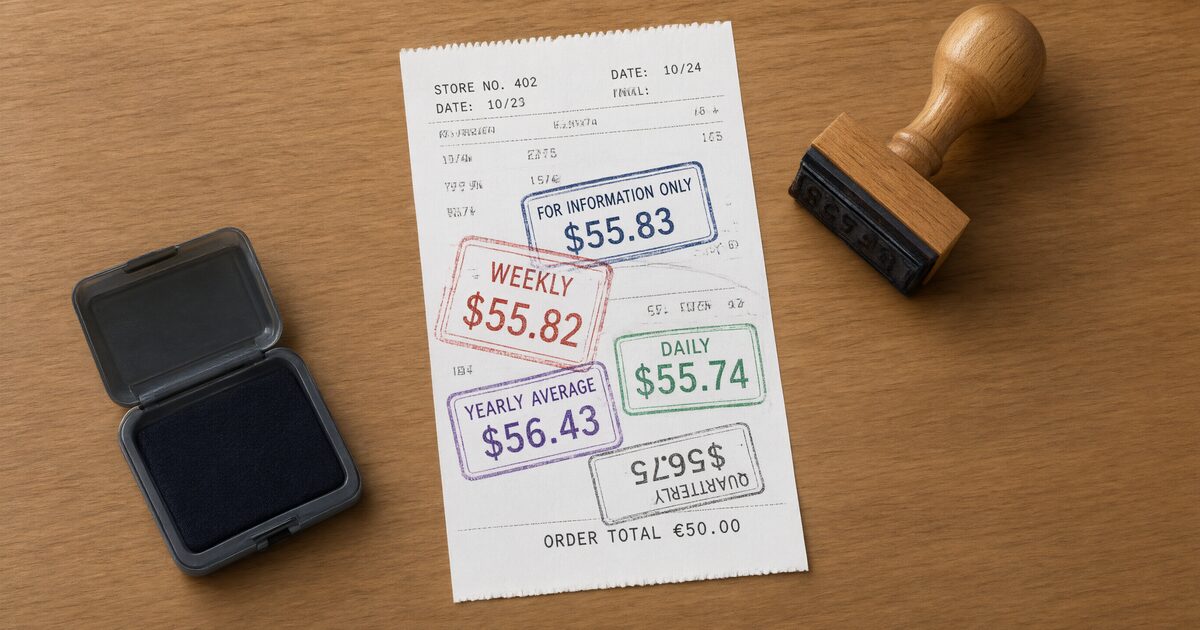
In 2026, your fridge can tell you the weather in Tokyo. Ask three central banks and the U.S. Treasury what a euro was worth in dollars on Sunday, November 8, and you get four answers:
- European Central Bank: 1.11651
- Federal Reserve: 1.11632
- Bank of Canada: 1.1147173
- U.S. Treasury: 1.1350744
Three of them are really talking about a Friday. One of those Fridays was the week before. The fourth is talking about the entire quarter.
Meet the cast.
The Federal Reserve publishes daily exchange rates. Once a week. On a Sunday, the newest week simply isn't out yet.
The European Central Bank publishes the most official euro rate in Europe, then adds that it is for information purposes only and not meant for transactions.
The Bank of Canada will happily tell you what a euro is worth, in Canadian dollars. Euros to U.S. dollars? Get a calculator: 1.5732 divided by 1.4113.
The U.S. Treasury sets its rate once a quarter, prints it upside down (0.881 euro per dollar), and goes back to more important things. It is also the only one of the four that claims to be valid on a Sunday. It claims every day from October 1 to December 31.
Guest star: the IRS, which doesn't do days at all. It says it has no official exchange rate, then publishes a table of yearly averages anyway. For 2025, 0.886 euro per dollar.5
Five agencies, four schedules, three currencies, two continents. And at stake, on a 50-euro order, about one dollar.6
There's an old story about Nasreddin sitting as a judge. The plaintiff makes his case. "You're right," says Nasreddin. The defendant makes his. "You're right," says Nasreddin. His wife objects: they can't both be right. "You're right too," says Nasreddin.
Now, without jokes.
None of this is a mess. Each rate was built for its own job, and each does that job well. Your accountant also knows which one the rules ask for. For the FBAR, the U.S. report on foreign bank accounts, it's the Treasury rate for December 31. In Canada, the tax agency accepts the Bank of Canada rate.
As for your prices, relax. Nobody's pricing lives or dies on that dollar.
So choosing isn't the hard part. Finding is.
Search data says the same. Hardly anyone types "which exchange rate should I use?" More than ten thousand people a month in Canada type "Bank of Canada exchange rate". More than a thousand in the U.S. type "IRS exchange rates 2025".7 People already know which rate they need. They're looking for where it lives.
And it lives in four different places, in four formats, with four ideas of what a weekend is. Somewhere on your team, someone has eleven browser tabs open right now, and three of them are central banks.
The fix is boring, which is how you know it works:
- Write the rule down once: whose rate, for which date or period, and what happens on weekends and holidays.
- Take the number from that publisher, and note the date it was actually published for. On a Sunday, that's usually a Friday.
- Keep a note of where it came from. A year from now, someone will ask.
The world will probably never agree on one exchange rate, and it doesn't have to. One rate for the whole world is a dream. One place for every rate is just engineering.
-
ECB euro foreign exchange reference rates, rate for Friday, November 6, 2026. ↩
-
Federal Reserve H.10, noon buying rates in New York, rate for Friday, October 30, 2026. Daily rates are released once a week. ↩
-
Bank of Canada daily exchange rates for November 6, 2026: 1.5732 Canadian dollars per euro and 1.4113 per U.S. dollar. 1.5732 / 1.4113 = 1.114717. ↩
-
U.S. Treasury Reporting Rates of Exchange, quarterly rate effective September 30, 2026, applied October 1 to December 31: 0.881 euro per dollar. 1 / 0.881 = 1.135074. ↩
-
IRS, Yearly Average Currency Exchange Rates, 2025: 0.886 euro per U.S. dollar. The same page says the IRS has no official exchange rate. ↩
-
Highest and lowest of the four Sunday rates: 50 × 1.135074 = $56.75; 50 × 1.114717 = $55.74; the difference is $1.02. Schedules: daily (ECB, Bank of Canada), weekly releases (Federal Reserve), quarterly (Treasury), yearly averages (IRS). Currencies: euro, U.S. dollar, Canadian dollar. ↩
-
Ahrefs keyword estimates, November 2026: "bank of canada exchange rate" in Canada, more than 10,000 searches a month; "irs exchange rates 2025" in the U.S., more than 1,000; "which exchange rate to use" phrases in the U.S., under 100 each. ↩